The Learning Curve #3: Five questions a vendor should answer in writing
The Teaching Move: The Five-Question Tool Test
I posted a five-question tool test a couple of weeks ago and the replies came back in two groups. Administrators said some version of "we ask three of these." Faculty said some version of "this is not my decision."
The second group is the one I keep thinking about. When you tell thirty students to go make an account on something so they can do the assignment, you have done procurement. You did it without a contract, without a data agreement, and without anyone's name attached. The decision was real. It just did not come with any of the protections a real decision comes with.
So here is the move, and it works whether you sign contracts or only write syllabi. Before a tool goes in front of students, make it answer five questions in writing:
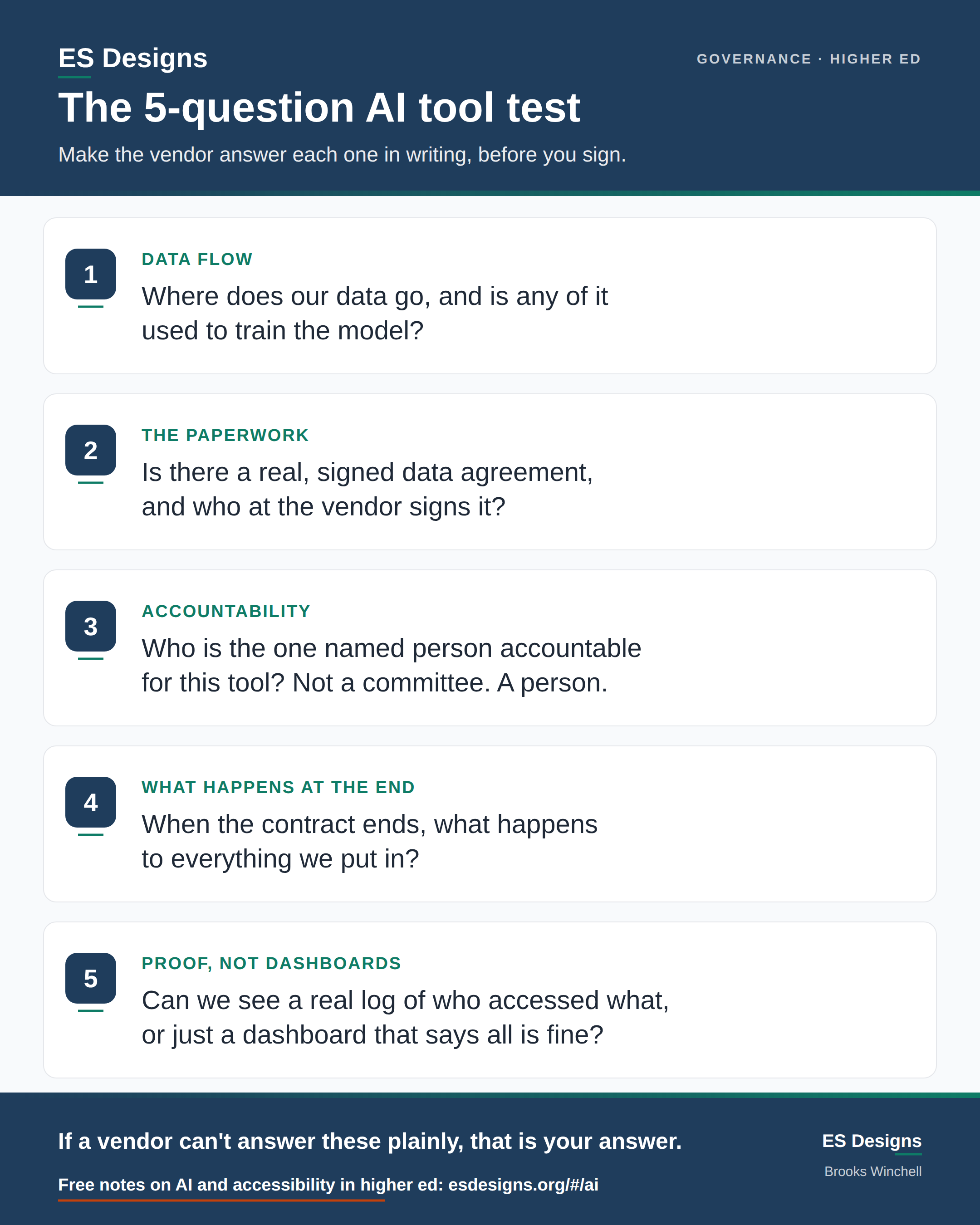
- Where does our data go, and is any of it used to train the model?
- Is there a signed data agreement, and who at the company signs it?
- Who on our campus is the named person accountable for this tool? Not a committee. A person.
- When the contract or the free tier ends, what happens to everything we put in?
- Can we see a log of who accessed what, or only a dashboard that says everything is fine?
Ten minutes this week. Take the one tool you are closest to adopting and answer all five without emailing anyone. On a free consumer tool the honest answer to two or three of them is "there isn't one," and that answer is the result you are looking for. Whatever you cannot answer is your list.
The accessibility note. Ask a sixth question every time: send us your accessibility conformance report, and tell us who tested this with a screen reader. Plenty of vendors will hand over a VPAT reading "supports" straight down the column, which is a document and not a test. The dates moved this spring. In April DOJ pushed the Title II web deadlines back a year, so public entities with a population of 50,000 or more now owe WCAG 2.1 AA by April 26, 2027, and smaller ones by April 26, 2028. A tool you adopt this fall is a tool you own on that date.
If you want the longer version of what changed with those dates, I wrote it up here: the ADA Title II deadline extension, explained.
The U of T and Cohere Deal, Translated
On July 16 the University of Toronto announced a multi-year partnership with Cohere, the Canadian AI company two of its alumni founded. Cohere's North platform will run inside U of T's own environment, connected to systems the university already uses, with U of T saying sensitive data stays under its control. Access runs to faculty, librarians, staff, and students.
The vendor is not the interesting part. The shape is. People were already using whatever they found. U of T's answer was to provide something sanctioned, with the data terms settled first. There is also a piece worth stealing that costs nothing. They call it the AI Kitchen, a named environment where a tool gets evaluated before anyone uses it for real. Most campuses I have worked with do not have one, which is why evaluation happens after adoption instead of before it.
You do not have U of T's budget and you do not need it for that part. Ask who on your campus owns the evaluation step. If the answer is nobody, that is a smaller thing to fix than the tool decision sitting on top of it. Hold the data-stays-with-us language loosely until you have read your own contract. It describes their deployment, and yours will read differently.
Worth five minutes for the framing: U of T's announcement of the Cohere partnership.
A Tool Worth a Look: Claude Opus 5
Anthropic released Claude Opus 5 on July 24, and it settled a question I had been losing time to. Their strongest model, Fable 5, is better at work that runs for hours, and it costs twice as much and burns through a usage window fast enough that I would watch the clock instead of the work. Opus 5 lands close to it on most of what I do, at half the price, and it holds up on the long jobs. It has been my default since it shipped.
The caveat is the same list from earlier in this issue. On a personal account there is no signed data agreement, no named person accountable, and no access log you can read. I run it on my own materials. Student work does not go in it.
P.S. If you read something here you disagree with, reply and tell me. I would rather be corrected by someone in the role than be polished and wrong. And if a colleague owns this work, forward it their way.
— Brooks Winchell. 21 years inside higher education, four of those at Quinsigamond Community College.